Why the HOA Fee on a Dorrington Cabin Listing Doesn't Mean What You Think
August 20, 2026
August 20, 2026
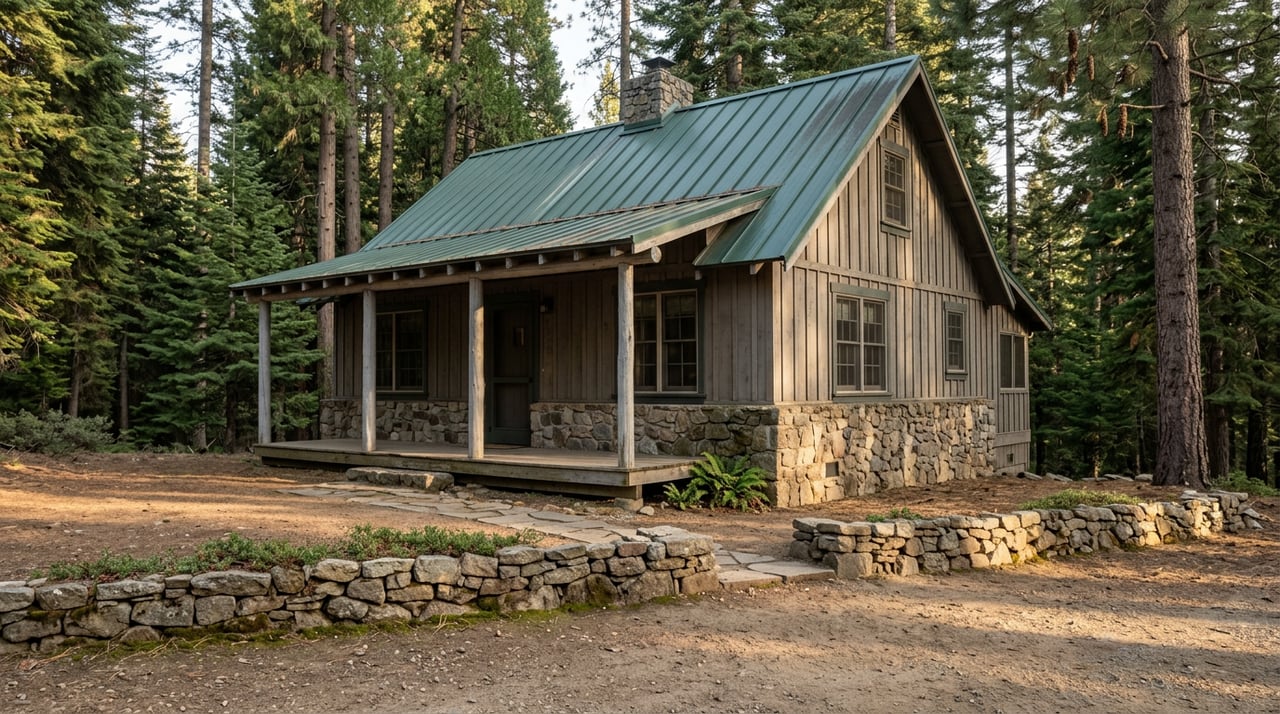
Why does one cabin off Highway 4 list HOA dues at around $150 a year, while the one three doors down lists dues near $900, described as mandatory? Both are in Dorrington. Both sit at roughly the same elevation, under the same pines, a short walk from the same stretch of road. The dues line on the listing sheet looks like a typo until you understand that Dorrington isn't one HOA market. It's two, occupying the same ground, with no fence or sign to tell you which one you're standing in.
The town of Dorrington and the surrounding Big Trees area grew in an unusual order. Snowshoe Springs came first, incorporated in 1957 as a small cluster of summer cabins near its own private lake. Then, through the 1960s and into the 1970s, American Forest Products developed the much larger Big Trees Village subdivision around it, eventually building out close to 2,000 home sites along a five mile stretch of Highway 4. Snowshoe Springs never merged into that later development. It stayed its own legal entity, sitting inside Big Trees Village's footprint like an island that happens to share a zip code with everything around it.
There's no boundary marker for a buyer to notice while touring homes. One local brokerage puts it plainly: figuring out which neighborhood you're standing in around Dorrington and Camp Connell takes a map, because there are no signs or gates to announce it. That's not a quirk. It's the reason two cabins a few hundred yards apart can carry entirely different obligations, and why the HOA line on a spec sheet is the start of a question, not the answer to one.
| Snowshoe Springs | Big Trees Village | |
|---|---|---|
| Established | 1957 | 1974 (development began mid-1960s) |
| Parcels | Roughly 300 to 360, depending on the source | Roughly 1,958 to 2,000 |
| Water | Bundled into dues via the association's own mutual benefit water company | Calaveras County Water District |
| Wastewater | Individual septic | Individual septic |
| Roads | Association-maintained | County-maintained, including snowplowing |
| Governance | Davis-Stirling Act | Voluntary property owners association |
| Amenities | Private lake, meadow, walking trails, reflecting pond | Two pools, tennis courts, playground, Frisbee golf course, roughly 15 acres of recreation land |
The Snowshoe Springs Association says it is governed under California's Davis-Stirling Common Interest Development Act, the same body of law that governs condo associations and gated communities statewide.
Big Trees Village works differently. The Big Trees Village Property Owners Association says membership is voluntary. Decline, and you keep your home, your septic system, your county-plowed road access, and simply skip the recreation center. Neither structure is better. They're different products wearing the same word, "HOA," on a listing sheet.
Here's where a buyer relying on a printed guide or an old flyer runs into trouble. Snowshoe Springs dues show up in different places as $868 a year and, more recently, as $1,080 a year. Big Trees Village dues show up as a flat $150 in one source and as a tiered $185 to $950 range in another, reflecting different membership levels including pool access.
Those aren't contradictions so much as evidence that dues change year to year, the way any HOA's budget changes with insurance costs, water system repairs, and deferred maintenance. The number that matters is whatever the association's current financial statement says today, not whatever a general area guide printed last year. Before writing an offer on anything in this corridor, ask the seller's agent for the current HOA disclosure package directly from Snowshoe Springs Association or Big Trees Village Property Owners Association, not a secondhand summary.
The same caution applies to the neighborhood's price data. One Redfin measure, pulled in the summer of 2026, puts Dorrington's average house price at $395,000, down more than 9 percent year over year. A separate Redfin measure for May 2026 puts the median sale price at $436,739, up better than 13 percent year over year. Same town, overlapping time window, two different answers, because a market this small produces a handful of closed sales in any given month and each one swings the average. The lesson carries over from the HOA table above: in a corridor this size, the specific parcel and its specific obligations tell you more than any headline number does.
One more distinction worth knowing before, not after, closing. Big Trees Village Property Owners Association holds a nationally recognized Firewise Community designation, maintained partly through a local lot inspection program that supports CAL FIRE's defensible space standards. The Big Trees Village Property Owners Association says membership makes that designation possible, and it's the kind of detail an insurance carrier may ask about when quoting a policy on a home inside that footprint.
Is every home in the Dorrington area part of an HOA? No. Snowshoe Springs and Big Trees Village cover large parts of the local footprint, but not every parcel in the broader Dorrington and Camp Connell area sits inside either association's boundary. Confirming this for a specific address is part of ordinary due diligence, not an assumption to make from the listing photos.
Does the Big Trees Village fee cover water or septic? No. Homes in Big Trees Village are on individual septic systems and get water through the Calaveras County Water District. The association dues pay for recreation access and shared amenities, not utilities.
Why do the dues figures I've seen online not match? Because they were pulled at different points in time from different sources. HOA budgets shift with water system repairs, insurance renewals, and deferred maintenance, the same way any small association's costs do. The only number worth relying on is the current one, requested directly from the association before you're in escrow.
Dorrington rewards patience more than most places, and that includes the paperwork stage. If you're comparing cabins in this corridor and want a second set of eyes on which association a specific listing belongs to, Lisa Clark has spent years working this stretch of Highway 4 and is glad to walk through it with you. Let's Connect.
This article is general information, not legal, tax or financial advice. Consult a qualified professional about your situation.
Stay up to date on the latest real estate trends.




Buying or selling a home is one of life's most important decisions, and having the right advisor by your side can make all the difference. Lisa Clark offers a highly personalized approach built on communication, market knowledge, and a genuine commitment to her clients' success. Whether you're relocating, purchasing a second home, preparing for retirement, or selling a longtime residence, Lisa provides thoughtful guidance and strategic advice tailored to your unique goals.
(209) 630-1893
[email protected]
415 MAIN ST
MURPHYS, CA 95247